
In William (Bill) Chenail’s room at Gibraltar Nursing Home, there is a framed photograph of him standing on a beach beside a young boy. They are both sun-tanned, their hair ruffled by the sea breeze. The boy, Bill’s son Bonner, is eight years old and bursting with pride. This is the day he caught his first ever fish.
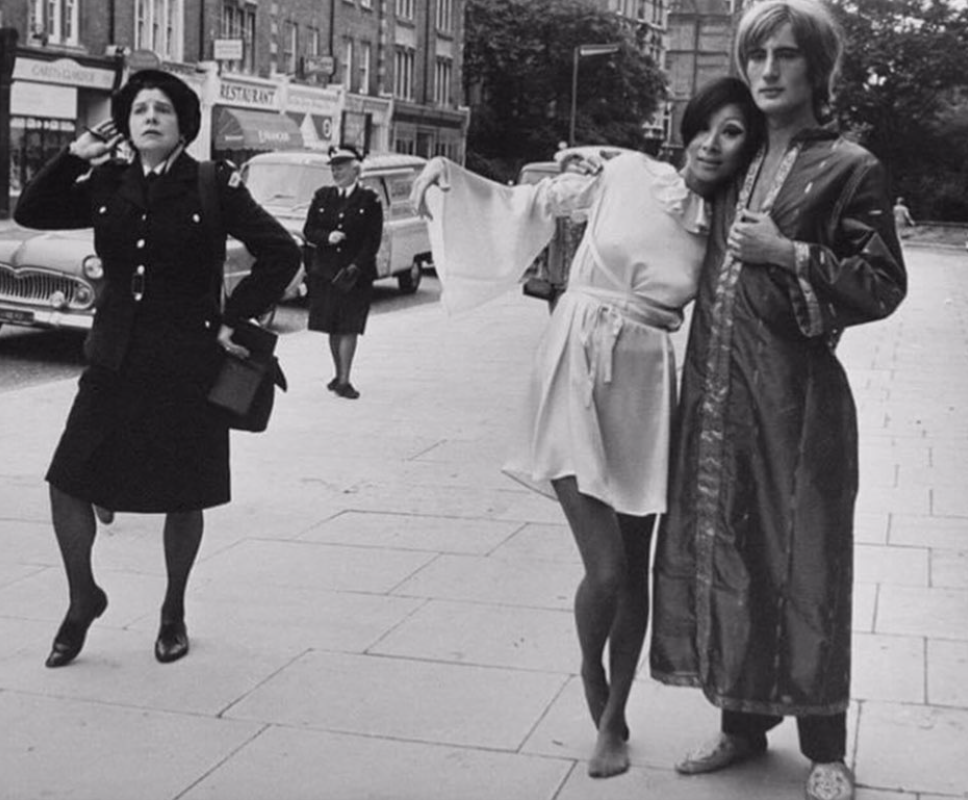
Nearby, on the desk, lies a detective novel by Alexander McCall Smith. A box of CDs, including artists like Michael Jackson and Bob Marley, rests beside an old-fashioned stereo. Then there are photographs that give people pause. In them, Bill is young, striking, and effortlessly confident – a successful model at a time when the fashion world was beginning to take risks and find its edge.
These are not simply decorations, but cherished fragments of a rich life well-lived. They are mementos of who Bill is, where he has been, and what has mattered to him.

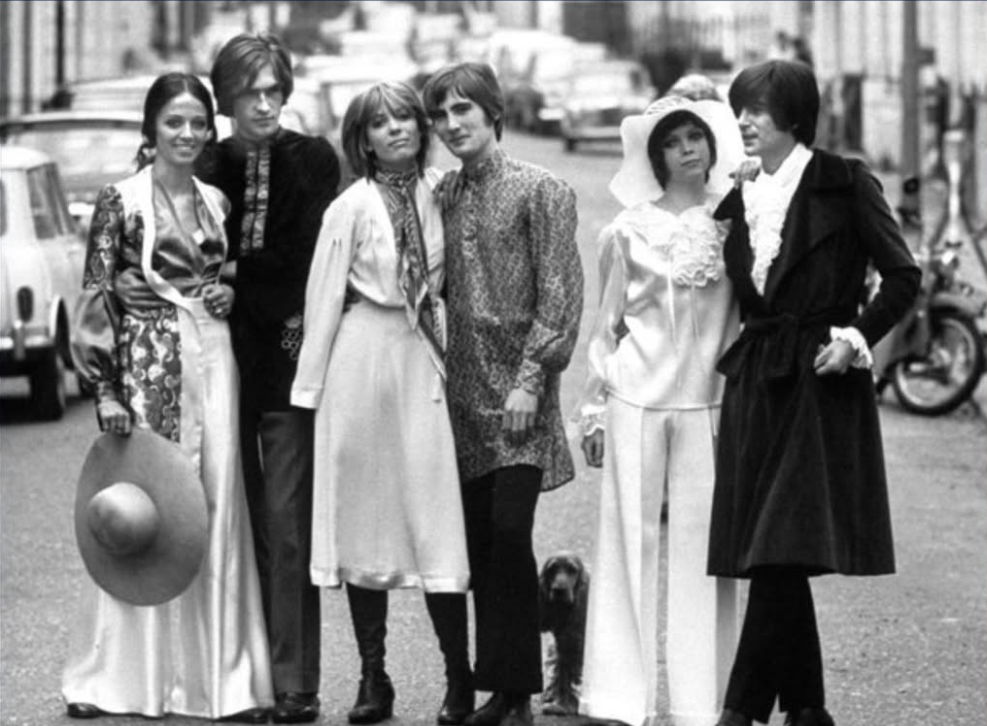
William (Bill) Chenail at Revolution Club fashion show for the English Boys, wearing Ossie Clark’s silver satin trousers.
The Early Years
Bill was born in 1948 in Casablanca, Morocco, to a Scottish mother and a French father who had immigrated there during the Second World War. When he was four, the family moved to Kent, where Bill attended a Catholic boarding school.
He hated school, especially having to say ‘Thank-you Master’, and remembers being struck by his teachers as discipline. What Bill did enjoy was English; he read avidly and began writing poetry in his teenage years. When he was about sixteen, Bill decided he’d had enough and ran away from school.
The Swinging Sixties
Bill moved to London around this time, embarking on the first chapter of his adult life. He wound up sharing a flat with Mick Jagger’s brother and describes those years as ‘very blurry.’ His girlfriend at the time was a model and she introduced him to the industry. Modelling was never something Bill had considered; he simply fell into it. The industry was still young at the time, and the pay was modest – nothing like it is today.
He was quickly picked up by the English Boys modelling agency and worked frequently with designer Ossie Clark. During these years, when he was based in Chelsea, one of his nicknames was ‘The Prince of the King’s Road.’

The Poet Behind Ruby Tuesday
Being a model gave Bill an open ticket to the vibrant London party scene. He attended a few Rolling Stones parties and rubbed shoulders with famous musicians and artists. It is likely that it was at one of these parties that he met Linda Keith, the girlfriend of Keith Richards.
Their brief relationship would later be referenced in Richards’ autobiography Life: ‘I found out that Linda had taken up with some poet, which I went bananas about…I even remember his name, Bill Chenail…’
Richards’ shared the catharsis he found in writing about the heartbreak and explained: ‘Basically, Linda is Ruby Tuesday’. Bill and Linda went their separate ways after a short time, and Linda ended up going on to start a relationship with Jimi Hendrix, who Bill also met briefly.
Music was always present in Bill’s life. He loved artists of the 1960s – Bob Dylan, Bob Marley, Michael Jackson – and was rarely without music playing in the background.
Despite these famous connections, Bill remained modest about his writing. According to his son, he has always been shy about sharing his work. He attempted some novels but mostly wrote poetry. It is unclear whether any of his work was ever published or not, but the act of writing clearly mattered deeply to him.
A Change of Direction
After his modelling days, Bill opened a rug shop in Chelsea, sourcing pieces through auctions and antique shops. He loved hunting for hidden gems. One of his proudest finds was a rare rug that he purchased for £100 and sold for £8,000. He later learned that it went on to sell for £100,000! Bill’s life was always full of surprising moments – including jumping into a lake to save the son of Lady Jane, with whom he was friends.
Bill also sadly experienced significant and unexpected losses in his life. His partner passed away when he was in his thirties, and their son Liam died tragically at the age of ten.
A Father’s Advice
In the mid-1980s, Bill met Bonner’s mother in Camden on a market day. They were together for a number of years before separating when Bonner was around four, after which Bonner moved to France to live with his mother. Despite the distance, they remained close, spending summers and Christmases together across England, France and Wales.
Bonner describes his father as deeply loving and supportive, but also firm. Bill valued independence, order, and not wasting money or food. When Bonner was seventeen and struggling, he moved to Wales to live with his dad for a time. Bill gave him an ultimatum: work or return to his studies. He pushed Bonner to become independent, stand on his own two feet, and make a life for himself. Bonner now credits that time with changing the direction of his life. He went on to become a chef, worked in Michelin-starred kitchens, was a personal chef to celebrities, and now creates food-related content.
A Time of Transition
Later in life, Bill moved to Brecon, Wales and then Crickhowell. During the Covid-19 pandemic, increasing isolation contributed to a decline in his health. After a hospital stay and a period living with a friend who attempted to support him as best they could, it became clear that his care needs were increasing.
Bill was diagnosed with Parkinson’s disease and living with a Dementia. These conditions affected his memory and orientation, and he required support to manage daily life safely.
Reflecting on this time, Bonner shared: ‘He used to take such good care of me. In recent years, I’ve done my best to take care of him, even though living in France made it difficult at times. After two years of part-time care at home, my siblings and I became increasingly worried about him. After visiting many places, I felt Gibraltar was the best option.’ Bill moved into Gibraltar Nursing Home in Monmouth in 2024.
Bonner lives in France but visits when he can. He and his father often speak French together – something Bill plays down modestly. Bill also has two other children, Debby and Shaun, who live in Scotland and Devon. They all describe him as being ‘incredibly competitive’ and a master at Scrabble.
Bonner describes the reassurance this decision brought: ‘I believe he’s very happy there, and I’m very happy too. He has a lovely garden just outside his window, and the staff have been amazing.’

Bill and team member Bridget, listening to some reggae together.

Bill taking part in card-making and craft activities at Gibraltar Nursing Home.
Life Continued
Bill’s life today is quieter than it once was. He often prefers to relax, watch his favourite television programmes and enjoy his own company. With gentle support from the team, he still listens to his music and occasionally chooses to take part in arts and crafts, opportunities to reconnect with creativity in ways that feel comfortable to him.
He’s supported to engage when he wishes, and respected when he chooses quiet instead. By understanding Bill’s history, passions and personality, the team are able to support him in ways that preserve the independent person he has always been.
Bill’s story reminds us that care is not about recreating the past, but about honouring the life that has already been lived and supporting it to continue in ways that feel right to him.
One of Bill’s poems reads:
I like to be on quiet beaches,
Eating ripe peaches,
Listening to the waves lapping
Onto the shore.
Softly soothing,
Liquid lullaby:
“Shush,” the sea sings,
“Shush,” she whispers
Into my ears:
“Forget your fears,
Forget your tears,”
And, for a while,
I am at peace.
And the infernal, internal
Dialogue is
Then silenced in
Me, by the sea,
The sea saying
“Shush! Shush! Shush! Shush!”

Bill Chenail’s poetry, shared by his son Bonner.
To read more stories about the people living and working at Gibraltar Nursing Home, please click here.